Stephen H. Smith, WA8LMF, recorded seven tracks of 1200-baud packet audio and put them on a CD in 2006. It is still the standard yardstick for comparing TNCs and software modems. He re-released it as FLAC files in 2025, and somewhere in the move three of the seven filenames ended up describing the wrong thing. Here are all seven, re-encoded from the original disc, relabelled, with the working shown.
0510152025 min
Track 1, whole. Twenty-five minutes of 144.390 MHz over Los Angeles at rush hour in 2006, with every gap longer than a second edited out. Almost every vertical stroke is a packet.
The seven tracks
Lossless FLAC, 44.1 kHz 16-bit, decoded from the 2009 disc image. Track numbers follow the original CD, so results anyone recorded over the last twenty years still line up.
01
144.39 MHz saturated channel Flat
25:47FLAC 109 MB44.1 kHz / 16-bit
Los Angeles at 5 pm, the APRS channel running at several hundred per cent of the Aloha threshold. Straight off the discriminator of a Yaesu FT-1500 via the 6-pin mini-DIN. Forty minutes of real activity with the dead air cut out. Over- and under-deviated signals, collisions, back-to-back packets, someone CW-IDing on packet.
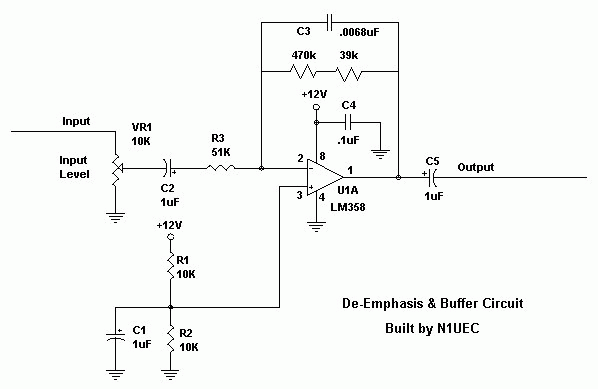
Track 1 through an EIA land-mobile de-emphasis curve with a roll-off below 200 Hz, standing in for audio taken at a receiver’s speaker or headphone socket instead of the discriminator.
Pair it with track 1 to see how a TNC copes with both.
Renamed Version 2 named this 02_100-Mic-E-Bursts-DE-emphasized.flac. The recording is track 1, de-emphasised.
One Kenwood TM-D700 Mic-E position report, captured flat from an IFR1500 service monitor and pasted end to end: 20 bursts a minute for five minutes, 100 absolutely identical packets.
Modulate a signal generator, wind the RF down until decoding fails, and read the success rate straight off the count.
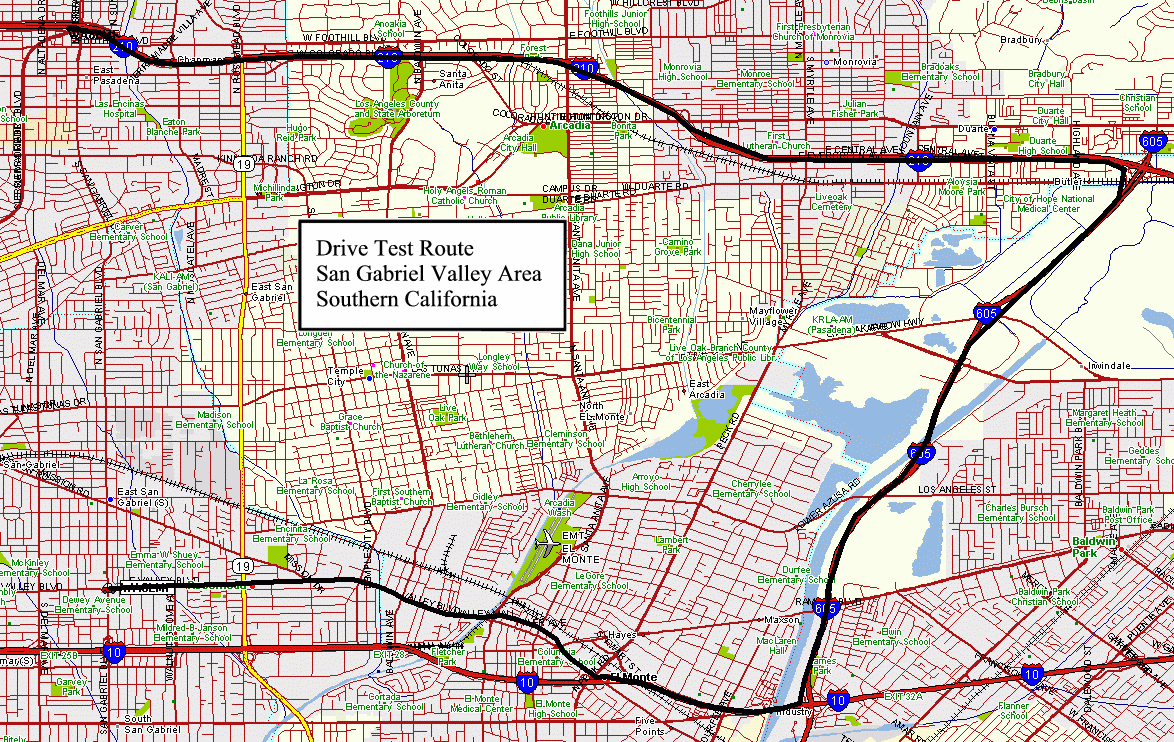
A single mobile TM-D700 beaconing every 12 seconds on an otherwise quiet channel, driven around the San Gabriel Valley and monitored from Pasadena 8–10 miles away. Flutter, multipath and loss of quieting throughout; some bursts are audible but never decoded.
Feed it to a TNC and watch a realistic moving station appear.
The file version 2 calls 02_100-Mic-E-Bursts-DE-emphasized.flac holds something else. It is track 1 — the 25-minute saturated-channel recording — put through a de-emphasis filter.
The audio is fine, and it is the same audio as on the 2009 disc. What slipped is a sentence. Both readmes say “Track 2 is identical to Track 3 except that a precise 6 dB-per-octave de-emphasis… has been applied”, where it should read Track 1. Nineteen years later, that sentence was the obvious thing to name the file after.
WA8LMF’s own supporting note on the 2009 disc — one of the files version 2 left behind — gets it right:
“On the CD, track one emulates receive via raw discriminator, while track two emulates de-emphasized receive via speaker or earphone jack. TNC developers are encouraged to use both tracks alternately…”
The lengths settle it on their own: track 2 runs 25:47, track 3 runs 5:05. But the proof is stronger than that. Line track 2 up against track 1 — they match at one exact sample offset, 54,689 frames — and measure the coherence between them. It sits between 0.998 and 1.000 from 100 Hz to 8 kHz. Coherence of 1 is what you get when one signal is a filtered copy of another and nothing else. The same test against tracks 3 and 4 gives 0.001–0.010, which is noise.
The filter that separates track 2 from track 1, measured directly: a peak at 300 Hz, a roll-off below it to keep CTCSS tones out, and a steep fall above. Repeated at three points 18 minutes apart, it agreed to within 0.02 dB.
The same measurement as numbers, with the coherence at each frequency — the part the curve above can’t show.
Track 1 to track 2 transfer function: gain and coherence by frequency
Frequency
Gain
Coherence
100 Hz
−18.9 dB
0.998
200 Hz
−1.2 dB
0.980
300 Hz
+7.1 dB
1.000
600 Hz
−4.1 dB
1.000
1200 Hz
−16.2 dB
1.000
2200 Hz
−25.8 dB
1.000
3000 Hz
−44.2 dB
0.998
4000 Hz
−32.8 dB
1.000
Worth knowing if you rely on this track
The readme calls the de-emphasis “a precise 6 dB-per-octave / 20 dB-per-decade” curve. Measured, it is steeper than that: between 500 Hz and 2500 Hz the slope is −11.9 dB/octave, and above about 3.5 kHz it stops falling and sits on a −32.8 dB floor.
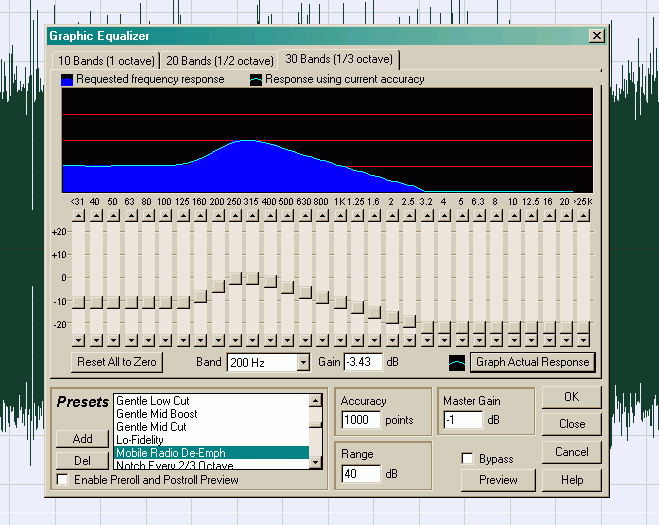
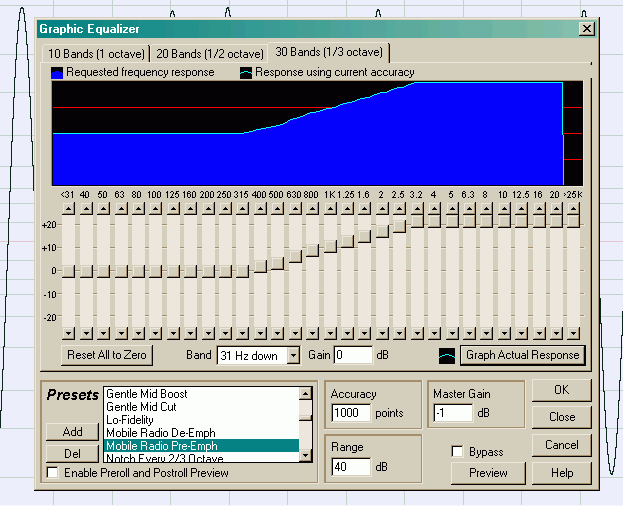
That is exactly what the disc’s own screenshot of the filter predicts. DeEmphEq.gif shows Adobe Audition’s graphic equaliser on its 30-band, one-third-octave tab, preset “Mobile Radio De-Emph”, with the top bands pegged at the bottom of their travel. That is a bank of fixed bands with a limited maximum cut rather than an RC network, which is exactly why the slope comes out steeper and then flattens.
Tracks 6 and 7 do hit the nominal rate; it is only track 2 that departs from it. The audio here is untouched either way — this is a property of the disc as published, worth knowing rather than worth fixing.
Tracks 6 and 7 are swapped
Version 2’s filenames have them the other way round, and so does the description on wa8lmf.net. The readme burned onto both discs gets it right — and so does the audio.
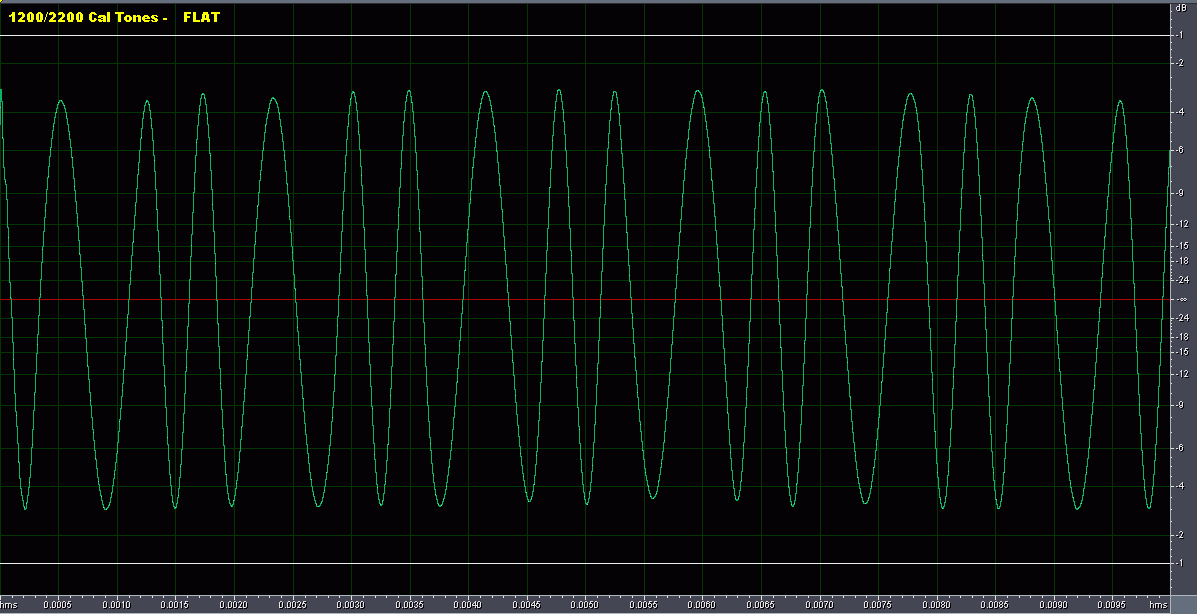
Track 5Flat
Both tones the same height.
Track 6Pre-emphasisedv2 called this de-emphasised
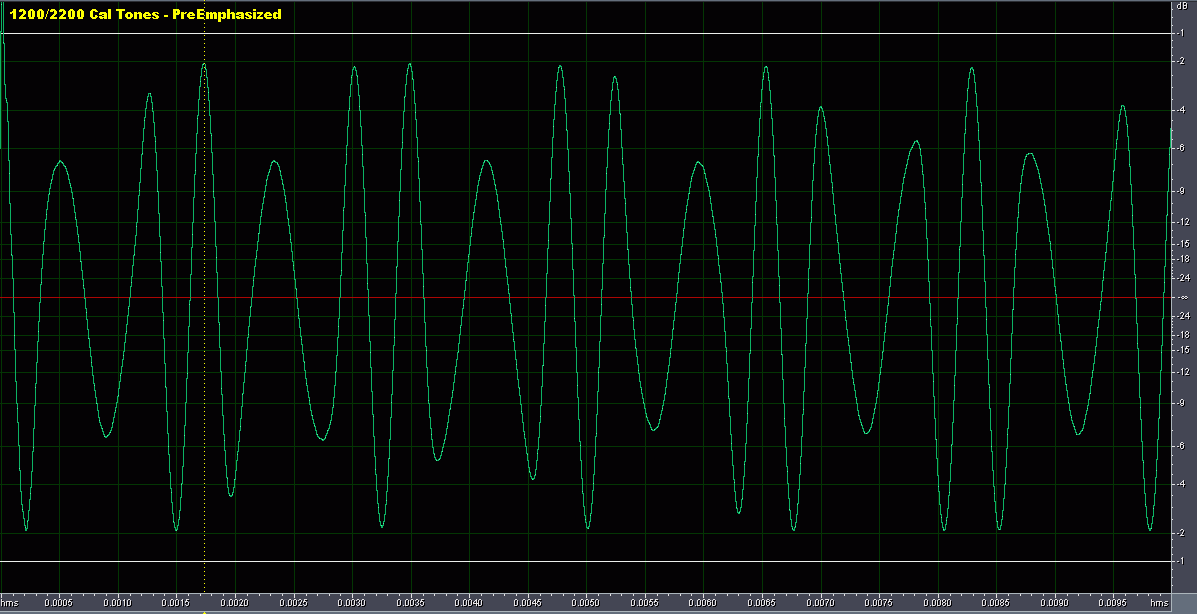
The narrow cycles are taller. High tone boosted.
Track 7De-emphasisedv2 called this pre-emphasised
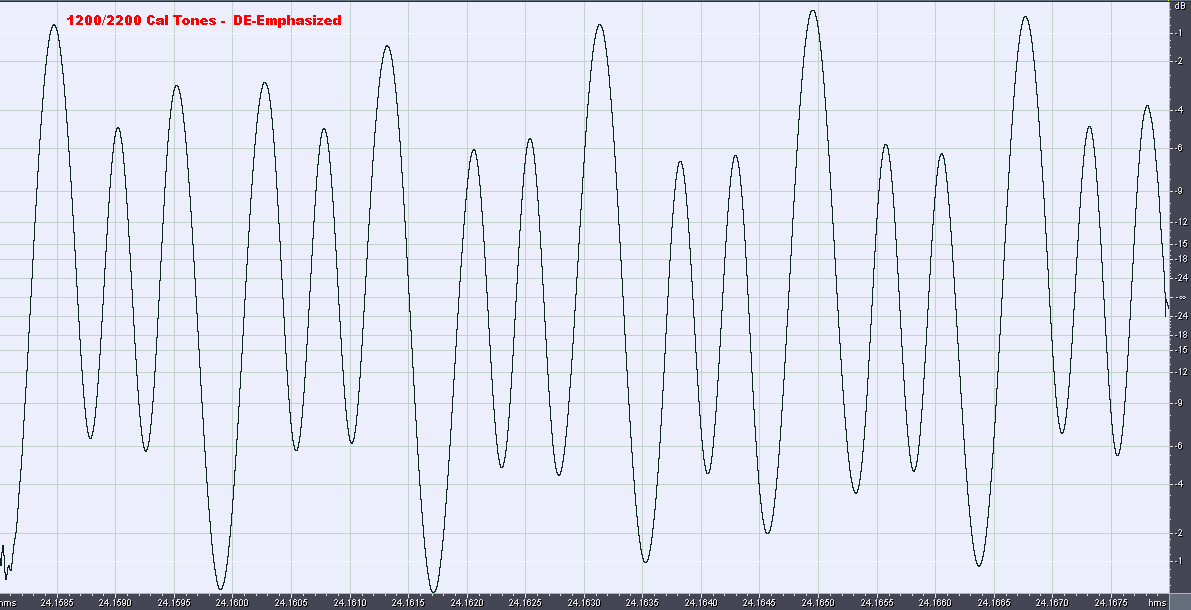
The wide cycles are taller. High tone cut.
Ten milliseconds of each track, drawn from the actual samples at the same instant. The CAL pattern alternates 1200 Hz and 2200 Hz, so wide and narrow cycles sit side by side and you can read the tilt straight off the trace. Pre-emphasis lifts the high tone; de-emphasis lifts the low one.
Measured against the flat track 5, both are filtered copies of it — coherence 0.9993 to 1.0000 — with mirror-image curves. Track 6 rises at +6.09 dB/octave; track 7 falls at −5.88 dB/octave. Rising with frequency is pre-emphasis. At 2200 Hz relative to 1200 Hz that is +5.04 dB and −4.84 dB respectively, against ±5.26 dB for a true 6 dB/octave.
The disc settles it a third time, with pictures. Its own reference images 1200-2200-PreEmph.gif and 1200-2200-DeEmph.gif show exactly the two traces above, in that order.
Version 2’s track 7 runs 152 seconds long
0:001:072:37 — 62 s of full-scale noise
Version 2’s 07_KPC3plus-CAL-tone-PRE-emphasized.flac runs 3:39 instead of 1:07. The tones stop at 1:07; then ninety seconds of digital silence; then sixty-two seconds of full-scale noise, where the rip ran off the end of the audio session and read the data track as audio.
If you are driving a service monitor’s modulation input at a level set for the tones, that tail arrives at full deviation. The copy here stops where the CD stops.
Where these files came from
Not from version 2’s FLACs, but from TNC_Test_Ver-1.1.bin — the 2009 mixed-mode disc image, which is the actual master. Each track was cut at the boundaries in the cue sheet, from INDEX 01 to the next INDEX 00, so the two-second pregaps are gone. They were checked first and hold nothing: peak amplitude 0 to 3 out of 32768.
Every file was decoded again after encoding and its PCM compared, byte for byte, against the source read out of the disc image. All seven match.
Version 2’s claim that “the contents of the files are identical to the original disk” holds up. Two small things turned up in the checking. Every version 2 track begins 667 frames early — an uncorrected drive read offset — and each of tracks 1 to 6 carries the next track’s two-second pregap on the end. Allow for those and the MD5 of every version 2 track matches the corresponding region of the 2009 image exactly. No audio was lost between the releases; nothing here is a second-generation copy.
How this was made
The analysis, the re-encoding and the writing on this page were done by Claude — Anthropic’s Claude Opus 5, running in Claude Code — working from the two disc images at M0LTE’s direction. M0LTE supplied the discs and had already spotted that track 2 wasn’t the Mic-E bursts; the tracks 6 and 7 swap, the track 7 tail and all the measurements came out of that work.
None of it asks to be taken on trust. Every claim here is a measurement that can be repeated, and the full technical write-up carries the sector ranges and checksums to reproduce any of it — including proving each track bit-identical to the original disc with nothing more than dd and md5sum.
The original documentation
Both discs’ readmes and reference images, kept as published. Five of them didn’t make it onto version 2, and two of those are still linked from its readme, so they are gathered back together here.